Recently on LinkedIn I wrote about the two stages where most companies get stuck on LinkedIn.
The Digital Ghost and The Reluctant Broadcaster.
A lot of people messaged asking about the other stages. And more importantly, what it actually takes to move through them.
So let’s get into it.
The corporate playbook is broken
For a decade, the LinkedIn strategy for most businesses looked the same.
Build a company page. Post brand updates. Hope someone notices.
In 2026, that approach isn’t just ineffective. It’s a liability.
Your prospective clients aren’t looking for a logo to follow. They’re looking for people to trust. And while your marketing team is busy crafting the perfect brand post, your competitors’ people are out there having the conversations that actually move deals forward.
The company page is your digital lobby. Professional. Polished. Passive.
Your people are your industry experts. When they’re silent, you’re invisible.
The data is not subtle
Employee networks are typically far larger than a company’s page following. Content shared by individuals consistently outperforms the same content shared by brand accounts. Leads generated through people-powered efforts convert more frequently than those from traditional advertising.
None of this is new information. Most marketing leaders I speak to know this instinctively.
The gap isn’t awareness. It’s architecture.
Where does your organisation sit?
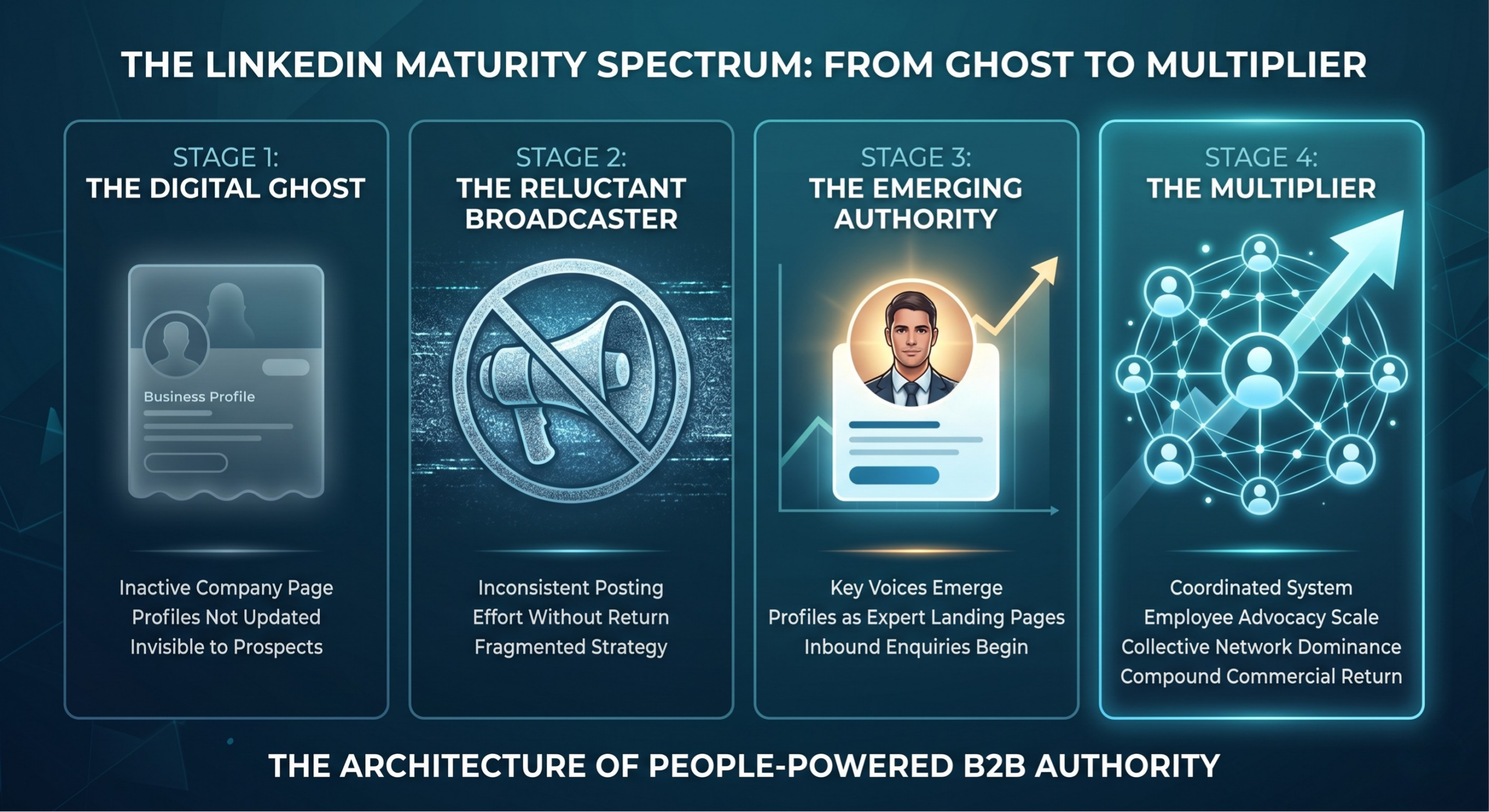
Most companies fall somewhere on a four-stage spectrum.
Stage 1: The Digital Ghost. The company page exists. The people don’t. Profiles haven’t been updated since the last job change. Your team has expertise that no one outside the building knows about. You’re invisible to prospects who are already researching your competitors.
Stage 2: The Reluctant Broadcaster. Someone is posting. But it’s inconsistent and uncoordinated. One or two executives are active sporadically. Content swings between too corporate and too personal. No shared framework. Effort without compounding return.
Stage 3: The Emerging Authority. Key voices are posting with some regularity. Profiles have been rebuilt as expert landing pages. Inbound enquiries mention LinkedIn. But the reach is still concentrated in a few individuals. The strategy hasn’t scaled.
Stage 4: The Multiplier. Executive presence, employee advocacy and social selling are operating as a coordinated system. Your team’s collective network dwarfs your page following. Decision-makers in your sector know your name before they issue an RFP. Inbound leads cite LinkedIn as the reason they reached out.
You’re not chasing authority. You’re compounding it.
Most companies I work with sit at Stage 1 or 2. That’s not a criticism. It’s the baseline for most B2B businesses right now.
The question is whether you move deliberately or stay put while your competitors figure it out first.
Why teams fail alone
Most employee advocacy initiatives stall before they get started. Three reasons come up every time.
The fear factor. Executives are paralysed by the idea of saying the wrong thing or looking unprofessional. So they say nothing.
The content friction. High-performers are busy. They don’t have hours to spend wondering what to post or how the algorithm works.
The alignment gap. Without a shared framework, individual efforts pull in different directions. The result is a fragmented presence that dilutes authority rather than building it.
The fix isn’t more activity. It’s the right architecture.
What this looks like in practice
I worked with a solar energy firm that had invested heavily in their company page. Solid following. Good content. And almost no commercial return from it.
We shifted focus to the people. Rebuilt profiles. Trained the leadership team. Activated a group of more than twenty senior employees.
Within 60 days, content impressions were up over 1,000%. Engagement on team-shared content was running at 8x what the brand page had managed. And leaders were reporting something they hadn’t expected: silent wins. Prospects reaching out who’d been reading for months without ever clicking a like.
One of them put it simply: “Our people are no longer just employees. They’ve become our most powerful marketing channel.”
That’s the multiplier effect.
If you want to see the full briefing, including the complete maturity spectrum and the people-powered framework behind it, I’ve put it together as a short PDF.
Download it here: http://www.nicholaskrul.com/wp-content/uploads/2026/05/Multiplier-Effect.pdf
And if you want to work through where your organisation sits and what the path forward looks like, let’s set up a quick call.
I’m a LinkedIn coach and trainer based in South Africa. I work with executives, sales teams and corporate communications professionals to build LinkedIn presence that drives commercial outcomes.